Feature article
The two policies that could shake up the property market after the election
Election uncertainty could slow spring property sales as two major tax policies come into focus.


AI summary
The upcoming election is creating uncertainty in the property market, potentially slowing spring sales. While elections typically affect sales volume more than prices, two key policies are causing extra hesitation for buyers and sellers.
These policies are:
- The Opportunity Party's proposed 1.75% land value tax.
- Labour's undecided position on interest deductibility for landlords.
While a temporary slowdown is likely, the actual post-election policy landscape will ultimately have a more significant and lasting impact on the market.
Elections can make people hesitate over buying and selling homes, even when they don't have much effect on house prices. As Stuff chief property correspondent Janika ter Ellen reports, this time that uncertainty is compounded by two big property-policy questions: Opportunity's proposed land tax and Labour's yet-to-be-settled position on interest deductibility for landlords.
ANALYSIS: How strong any property market pause is this election will partly depend on whether those policies look more likely to happen. We’ll dive into that in a moment.
More broadly, market watchers say elections tend to have a more noticeable effect on the number of homes being bought and sold than on prices.
Bayleys head of insights and data Chris Farhi has been monitoring the effect of New Zealand elections on the property market and says the 2014 and 2017 election period saw sales activity fall to about 85% of what they would normally see at that time of year.
“A big part of that was because housing policy was front and centre at that time. Housing affordability was up in lights. We had a lot of policy debate around capital gains tax, foreign buyer bans, bright line tests, and those sorts of things.”
But a look back at the price data shows what people actually paid for homes didn’t really fall because of the election.
The 2020 election was an outlier, with property sales extremely high, but Farhi says that was driven by very low interest rates during Covid and a broader boom.
Then last election in 2023, when house prices had already fallen and sales volumes were close to their lowest in the latest downturn, there was barely any change in sales volumes at all. We’d already bottomed out.
The effect of elections is overshadowed by the wider economy, and it also depends on whether property-related policies end up becoming a big part of the pre-election debate, and how likely policy change looks.
So when will the usual sales slowdown happen?
There are different views on that one.
“We actually believe that the spring selling season will probably come forward a month,” Trade Me Property customer director Gavin Lloyd says. That’s because of the slightly later election, which is on November 7.
He believes more activity could arrive in August/September rather than the usual September/October period, as people wanting to sell before the election bring their properties to market earlier.
But Loan Market Agile mortgage adviser Rodney King expects the opposite.
“With the election being later than normal in November, after the election it’s basically Christmas, then January is a write off,” he says. “It could be fairly subdued right through until February before we see the usual post‑election pick-up in activity.”
The party that wants house prices to fall 10-15%
Ok, onto the two big biggest proposed shifts in property policy. The first comes from the Opportunity Party.
The party - which is polling at 6.1% in the Taxpayer Union-Curia poll, enough to get into Parliament - wants a 1.75% land value tax. The party projects the policy would see house prices drop by 10-15%.
It says this would encourage business investment instead and high-density property development. It also states most people would still be better off because of their wider proposed tax changes. You’d have to do the maths on your situation to work out the effect on you.
It’s not to say this will actually happen, of course, even if they do get into government.
Infometrics managing director and chief forecaster Gareth Kiernan explains: “I don’t think it will be enacted because they're only going to have a relatively small portion of the pie. But even then, they might have some influence on how the policies come out the other side of the sort of any coalition talks.”
Labour's big unknown
Probably the biggest question for the property market is Labour’s position on interest deductibility.
Currently, when landlords have a mortgage on a rental property, the interest they pay can be deducted from rental income when calculating their tax, so it brings the bill down.
The previous Labour government unwound this practise, which they called “tax-cuts for landlords.” The current government then brought it back.
Property policy: what we know, so far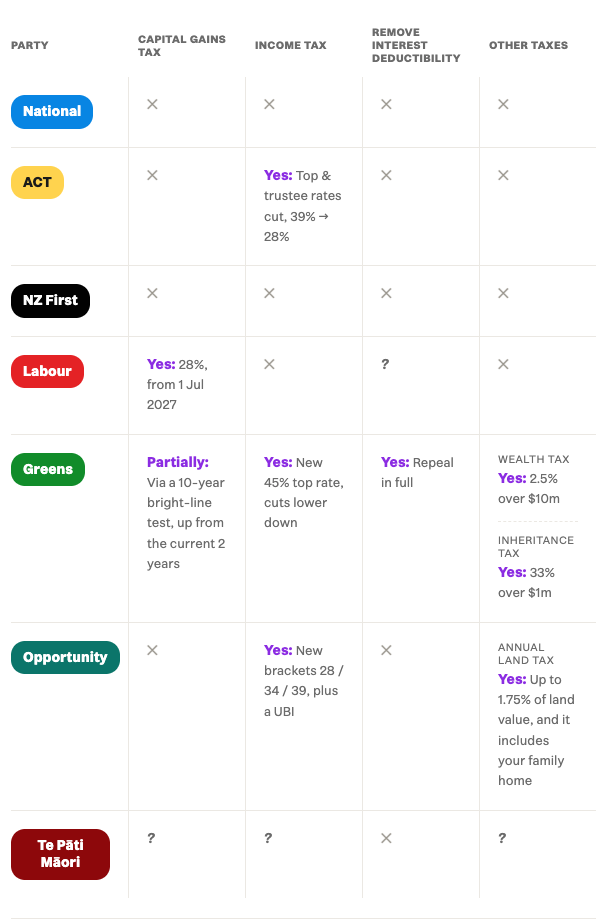
Positions as at August 3
Property Investors Federation advocacy manager Matt Ball believes Labour may be considering a middle path this time, allowing landlords to deduct interest on only half their mortgage costs.
If announced and brought in, this would lift the ongoing tax property investors pay, unlike Labour’s already-announced capital gains tax, which only applies when investment properties are sold. (It doesn’t apply to the family home.)
You can read more here about how likely interest deductibility change is, and how it could affect house prices and rents.
There are other property-related tax proposals in the mix, including the Greens’ proposed wealth and inheritance taxes, although their effect on the housing market would depend on how the policies were implemented.
In the end, the election itself may slow the market down temporarily. But what happens afterwards, and how the policies of potential coalition partners interact, matters much more.
This article was originally published by stuff.co.nz
Author
Other articles you might like